A Reflective Review of Divya Drishti by Pankaj Malik:
Divya Drishti by Indra Prasad Oli is not just a book about drugs; it is a mirror held up to Nepalese society. Written by a former narcotics officer with decades of field experience, the book speaks with honesty, urgency, and deep social concern. Rather than presenting dry statistics or theoretical arguments, Oli chooses to tell stories—stories that reveal how drug abuse quietly enters homes, schools, and communities, often unnoticed until the damage is already done.
What makes Divya Drishti distinctive is its grounded perspective. The author writes as someone who has witnessed the consequences of drug abuse firsthand—on the streets, in police stations, and inside broken families. His language is direct and accessible, making the book readable not only for professionals but also for parents, students, and ordinary citizens. This accessibility is one of the book’s greatest strengths.
The book carefully explains how young people are drawn into drug use, often through curiosity, peer influence, emotional distress, or lack of guidance. Oli avoids blaming individuals; instead, he highlights the social conditions that make drug abuse possible. Unemployment, migration, weak family structures, and lack of awareness emerge as recurring themes. Through real-life incidents, the author shows how addiction gradually erodes a person’s health, relationships, and sense of purpose.
Another powerful aspect of Divya Drishti is its exposure of how urbanization and open borders have increased drug availability in Nepal. Cities and border areas are described not just as locations, but as environments where drugs circulate easily due to poor monitoring and social neglect. These observations make the reader aware that drug abuse is not a distant problem—it is embedded in everyday spaces.
Unlike many books that focus only on law enforcement, Divya Drishti repeatedly emphasizes prevention and awareness. Oli argues that policing alone cannot solve the problem unless families, schools, and communities are actively involved. His call for collective responsibility gives the book a strong moral foundation. The reader is left with the feeling that social change is possible, but only through shared effort.

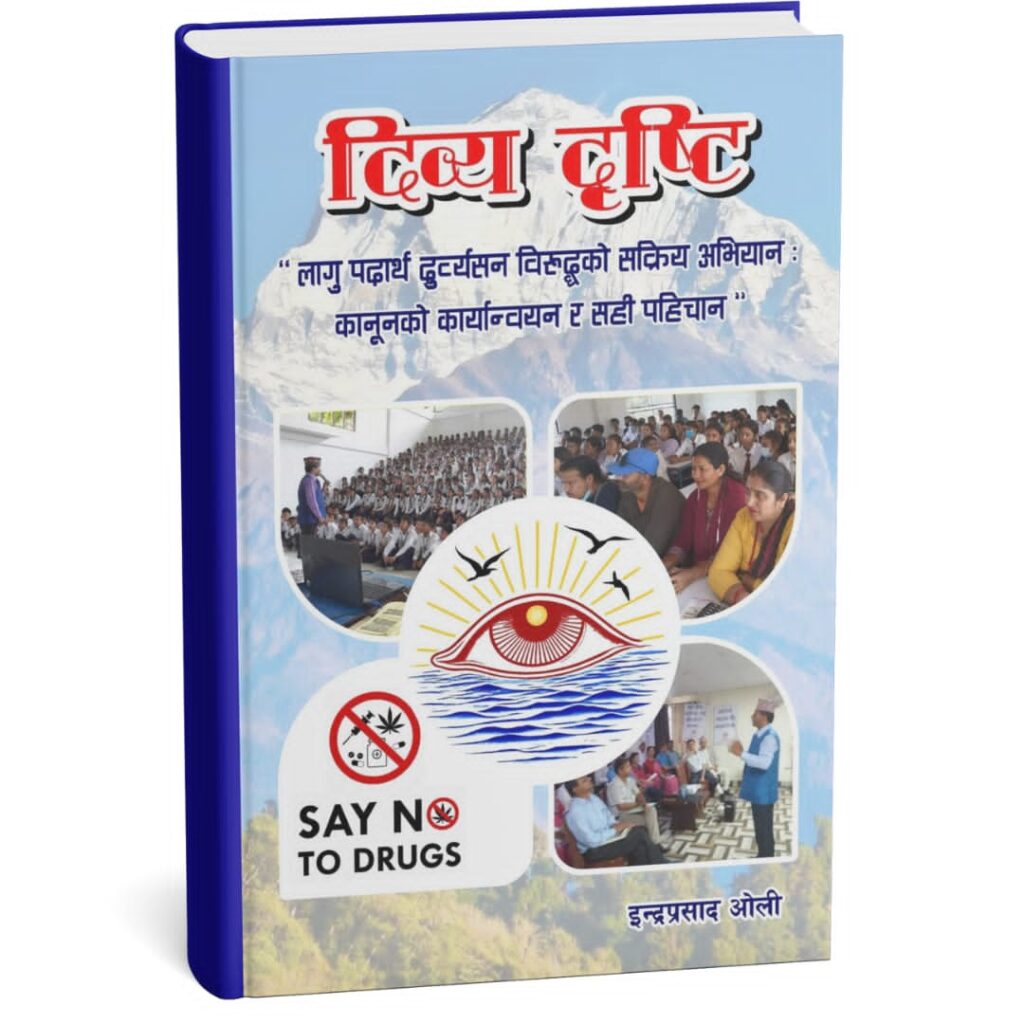
Overall, Divya Drishti is a sincere and socially committed work that succeeds in raising awareness about one of Nepal’s most sensitive and growing challenges. It does not sensationalize drug abuse; instead, it humanizes it. The book is especially meaningful for parents, teachers, youth workers, and anyone concerned about the direction in which society is moving.
In a time when drug abuse is often discussed only after tragedy strikes, Divya Drishti serves as an early warning—and a call to conscience. It is a book that encourages readers not just to understand the problem, but to take responsibility for preventing it.