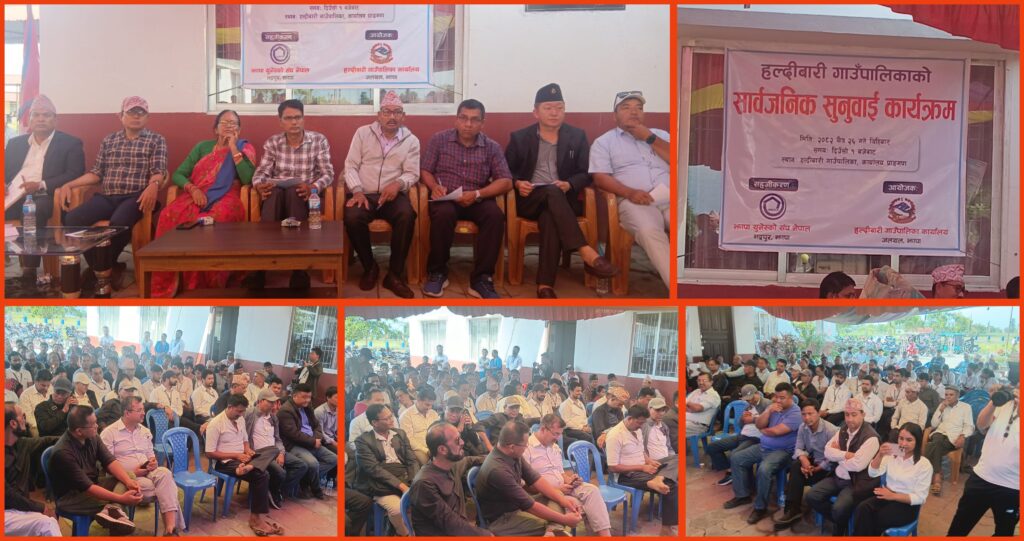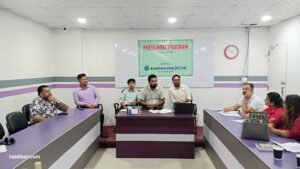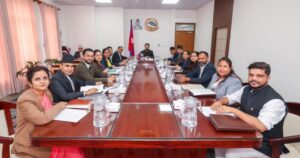
Haldibari (Jhapa): The Haldibari Rural Municipality of Jhapa has successfully conducted a public hearing program focused on ensuring good governance and transparency. Chaired by the Rural Municipality Chairperson, Rabindra Prasad Lingden, the event saw local residents raising inquiries and grievances regarding infrastructure, health, education, drinking water, agriculture, and tourism.
During the hearing, 14 local participants raised approximately 40 questions related to the overall development and service delivery of the municipality. Responses to these queries were provided by Chairperson Lingden, Vice-Chairperson Laxmi Devi Mainali, and Chief Administrative Officer Man Bahadur Ban (Mahendra), along with Ward Chairs Devi Bahadur Thapa, Shuklal Rajbanshi, Bishnu Prasad Oli, Sant Kumar Thapa, and Khadga Lawati.
Addressing the program, Chairperson Lingden stated that Haldibari has prioritized development projects by keeping the basic needs of the people at the center. “Due to the shared cooperation and support of all political parties, Haldibari has succeeded in ranking first in Jhapa district under the ‘Best Practices’ program,” Lingden remarked. “This achievement belongs to all the residents of the municipality.”
Similarly, Chief Administrative Officer Man Bahadur Ban mentioned that the municipality is striving to achieve maximum results with a limited budget by practicing economic austerity. He further urged all political parties to play a constructive role and coordinate in securing additional budget allocations.
The public hearing saw active participation and questioning from Ganga Prasai (President of Nepali Congress), Ekraj Rana Magar (President of RPP), Khagen Rajbanshi (President of CPN), Kedar Prasad Upreti (Chairperson of Jalthal Drinking Water), Harka Tamang (Vice-Chairperson of haldibari Drinking Water), and Santosh Kumar Meche (SMC Chairperson of Dipendra Basic School). Local leaders Dharma Raj Shiwakoti, Lal Bahadur Kandangwa, Kaidi Mabo, and media persons Indrajit Mukhiya and Lekhnath Pardeshi also raised questions regarding the overall development of the area.
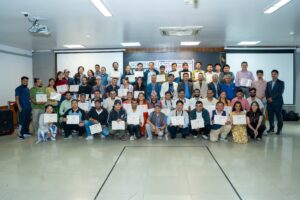
Facilitated by the UNESCO Association of Nepal, the program was attended by a large number of elected representatives, government employees, representatives of various political parties, stakeholders, and journalists.